Gabriela M. et al (2025). Spatial distribution of technology-critical elements in boreal lakes
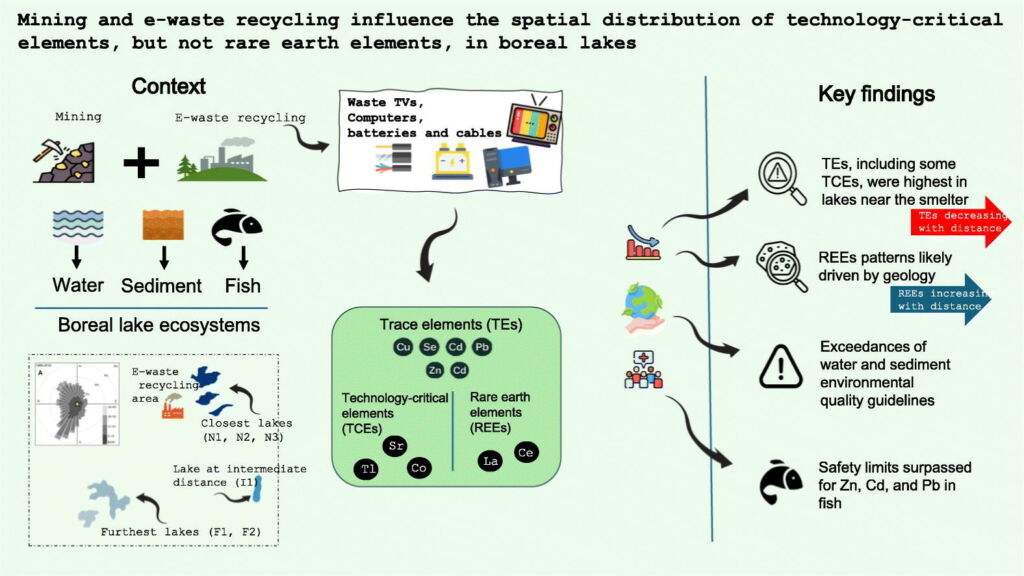
This study, conducted in six boreal lakes in the Rouyn-Noranda region of Abitibi-Témiscamingue (Quebec, Canada), aimed to characterize the spatial distribution of trace elements, including critical technological elements and rare earth elements, to compare the measured concentrations with environmental quality criteria, and to assess the risk associated with fish consumption, based on sampling of water, sediments, and liver and muscle tissues of walleye and yellow perch along a distance gradient from the Horne smelter.
Abstract: Mining and more recent e-waste recycling have contributed trace elements (TEs) to the environment. However, the occurrence of emerging technology-critical elements (TCEs), including rare earth elements (REEs), remains poorly reported. Our study aims to i) investigate the spatial distribution of TEs, including TCEs, across different environmental matrices; ii) compare measured concentrations in water and sediment against environmental quality guidelines; and iii) assess potential risks to human health from fish consumption. In this study, we sampled water, sediment, and fish tissues (muscle and liver) across six boreal lakes near the historically mining region of Rouyn-Noranda, home to North America's largest copper smelting and recycling facility (Horne Smelter). Concentrations of TEs (e.g., Cu, Se) were higher in lakes closest to the smelter. Similarly, some TCEs (i.e., Ti, Co, Tl) followed this same spatial distribution pattern, suggesting that their release may be linked to historical and current mining activities. Conversely, REEs displayed distinct spatial patterns, likely influenced by geological sources rather than pollution. Several TEs (e.g., Zn, Cd, Pb) exceeded Canadian water and sediment quality guidelines in lakes closer to the mining area. Muscle tissue from walleye or yellow perch showed Zn, Cd, or Pb concentrations above safety limits in at least one lake. This study highlights the importance of including emerging TCEs (e.g., Sr, Tl, Co) in biomonitoring programs. Our findings provide critical insights into the environmental distribution of TEs across multiple matrices of boreal lake ecosystems, contributing to global efforts in risk assessment and sustainable freshwater management in the context of growing electronic waste recycling.
Full citation:
Gabriele, Marta, Maikel Rosabal, Miguel Montoro Girona, Patrice Blaney, et Guillaume Grosbois. « Mining and e-waste recycling influence the spatial distribution of technology-critical elements, but not rare earth elements, in boreal lakes ». Science of The Total Environment 1007 (10 décembre 2025) : 180916. https://doi.org/10.1016/j.scitotenv.2025.180916.
Content blocked
This content is blocked because you have not accepted analytical cookies.
Once cookies have been accepted, please refresh the page.